
Aquaculture drum filter buyer guide
How to Choose an Aquaculture Drum Filter: 8 Key Factors Before Buying
Choosing an aquaculture drum filter is not simply a matter of matching a model to tank volume. A filter that appears suitable on a product sheet may still be wrong for the project if the design flow, solids load, hydraulic arrangement, cleaning-water supply or discharge route has not been defined.
For a commercial fish farm or recirculating aquaculture system (RAS), the buying decision affects more than water clarity. Mechanical filtration sits upstream of biological treatment and influences how much suspended waste continues through the system. The right selection should support stable circulation, practical maintenance and reliable integration with pumps, pipework and downstream treatment equipment.
This guide explains how to choose a drum filter for a fish farm using eight buyer factors. It is intended for project evaluation and quotation preparation—not for replacing the hydraulic design of an aquaculture engineer.
For fish farms, hatcheries, RAS integrators and aquaculture equipment buyers.
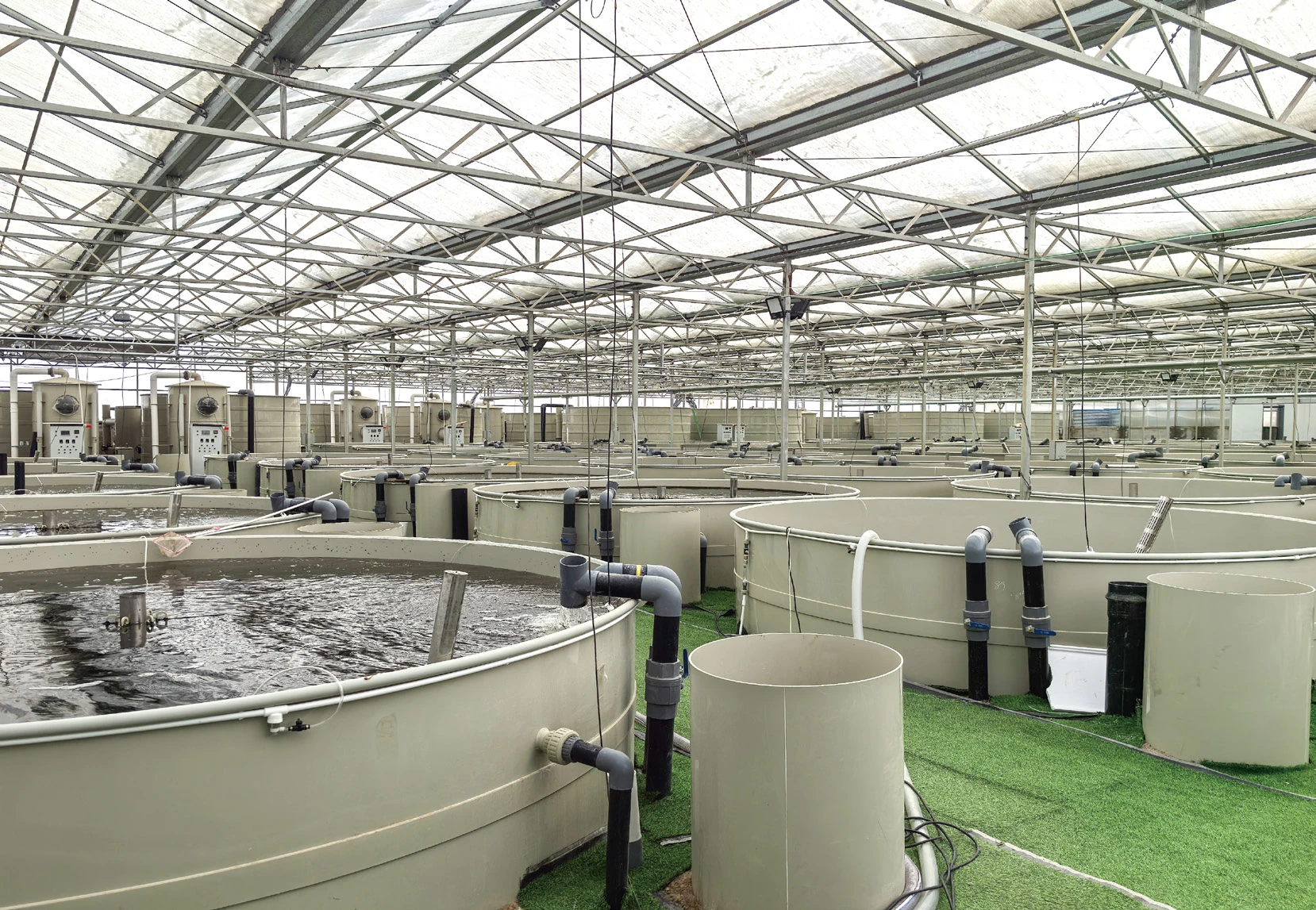
Commercial aquaculture production environment with multiple tanks and centralized water circulation.
Selection framework
The Short Answer: Select by System Duty, Not Tank Volume Alone
A useful drum-filter inquiry starts with five items:
- Design and peak water flow.
- Fish species, production stage and expected biomass.
- Feeding rate and solids characteristics.
- Hydraulic layout and available installation space.
- Required screen, connections, power supply and maintenance access.
Tank volume helps establish the scale of a system, but it does not define the required filter capacity by itself. Two farms with the same total water volume can have very different turnover rates, stocking densities, feed inputs and operating risks. Model selection should therefore be based on the complete operating duty.

RAS treatment sequence
Where the Drum Filter Fits in an RAS
A common RAS treatment sequence is:
Fish tanks → mechanical drum filter → biofilter → oxygenation → disinfection, where required → return water
The drum filter is the first-stage mechanical separator. Water enters the unit and passes through a screen. Suspended particles remain on the screen while filtered water continues to downstream treatment. As retained solids restrict the screen and create a water-level difference, the cleaning cycle rotates the drum and spray nozzles wash the captured material into the waste channel.
The drum filter does not replace biofiltration, oxygen control or disinfection. Its role is to remove suspended material before those stages. That separation matters because uneaten feed and fish waste can break down if they remain in circulation, adding organic load to the water-treatment process.
For a broader product explanation, see the Drum Filter Overview. For a commercial application route, visit the Aquaculture Drum Filter product page.
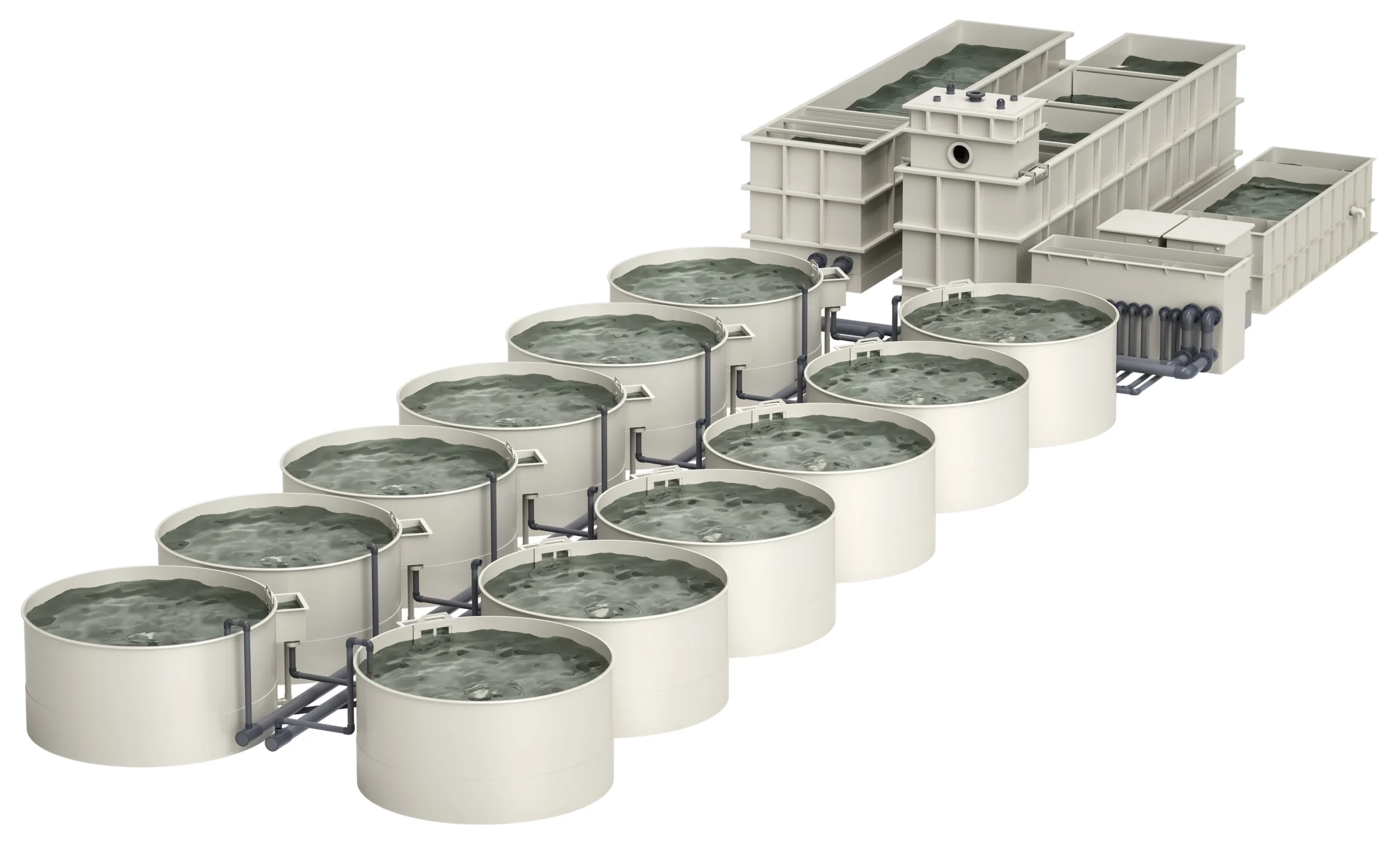
Reference RAS layout showing production tanks connected to centralized treatment equipment.
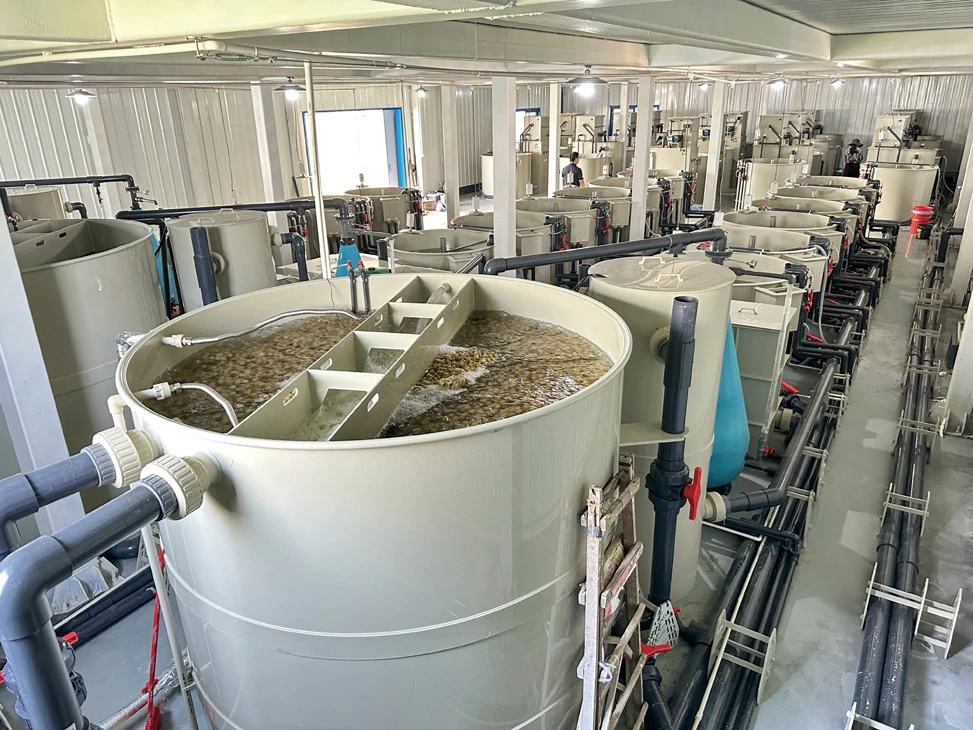
Reference RAS treatment environment showing tanks, pipework and centralized water processing.
The operating problem
Why Suspended-Solids Management Matters
Commercial aquaculture systems continuously produce solids. Their quantity and particle characteristics change with species, fish size, feed type, feeding rate, tank hydraulics and farm-management practices. Typical sources include fecal matter, uneaten feed and other suspended organic material.
If these solids are not separated promptly, smaller particles may circulate through the system and become more difficult to capture. Solids can also increase the workload on downstream treatment, collect in low-flow areas and complicate routine cleaning. A drum filter helps by continuously screening the circulating water and automatically removing retained material from the process flow.
The selection question is therefore not “Which filter makes the water look clear?” It is “Which mechanical separator can handle the expected hydraulic and solids duty without creating an avoidable bottleneck?”
Buyer factors 1–2
Define the hydraulic and production duty first
Factor 1: Design Flow Rate and Peak Flow
Flow rate is the first sizing input. Ask the system designer for the design flow through the drum filter, normally expressed in m³/h, and identify whether short-term peak conditions are possible.
Do not calculate filter capacity from tank volume alone. Tank volume must be considered together with the intended turnover rate, the number of filtration lines, pump operating points and any recirculation or bypass arrangement. If several tanks discharge to one filter, use the combined flow that can reach the unit under the planned operating condition.
Before requesting a quotation, confirm:
- Normal design flow and possible peak flow.
- Continuous or intermittent operation.
- Number of tanks and filtration lines.
- Planned redundancy or bypass.
- Future expansion that may add flow.
Treat a published flow figure as a model-screening value, not an unconditional guarantee. Actual hydraulic capacity can be influenced by screen condition, water level, solids loading and installation arrangement. Pursun should confirm the model against the project information supplied.
Factor 2: Species, Production Stage, Biomass and Feed Load
Flow describes the water duty; production data helps describe the solids duty. A hatchery, juvenile system and grow-out farm can require different mechanical-filtration decisions even when their flow rates are similar.
Provide:
- Fish or shrimp species.
- Hatchery, nursery, grow-out or holding application.
- Current and maximum expected biomass.
- Daily feed input and feeding pattern.
- Any known solids or water-quality concerns.
- Seasonal or batch-related changes in production.
Biomass and feeding data help the supplier understand whether the filter will face a relatively steady load or stronger peaks. For example, feeding periods may create short-term solids increases that are not visible in a simple average-flow figure.
Avoid using “fish type” as the only biological input. Species matters, but the production stage, biomass and feed load usually provide more useful engineering context for preliminary selection.
Buyer factor 3
Factor 3: Screen Selection and the Separation Objective
A finer screen is not automatically the better choice. Screen selection is a balance between the particle-removal objective, hydraulic capacity and cleaning demand.
Ask what the mechanical stage needs to accomplish:
- Protect downstream biological treatment.
- Capture feed and fecal solids before they fragment.
- Improve suspended-solids control in production water.
- Reduce material reaching later treatment stages.
Then discuss the available screen specification with the supplier. A finer opening may retain smaller particles, but it may also restrict flow more quickly and trigger more frequent cleaning under a heavy solids load. A coarser screen may provide more hydraulic margin but allow smaller material to pass. Research on microscreen operation also shows that mesh choice and operating conditions affect separation and backwash behavior; it should be treated as a system decision rather than a marketing number.
The approved Pursun product material identifies a 200-mesh 316L stainless-steel filter screen for the documented configuration. Do not assume that every project or model uses the same screen. Confirm the offered specification in the quotation.
Automatic spray cleaning removes retained solids from the rotating screen and directs them to the waste channel.
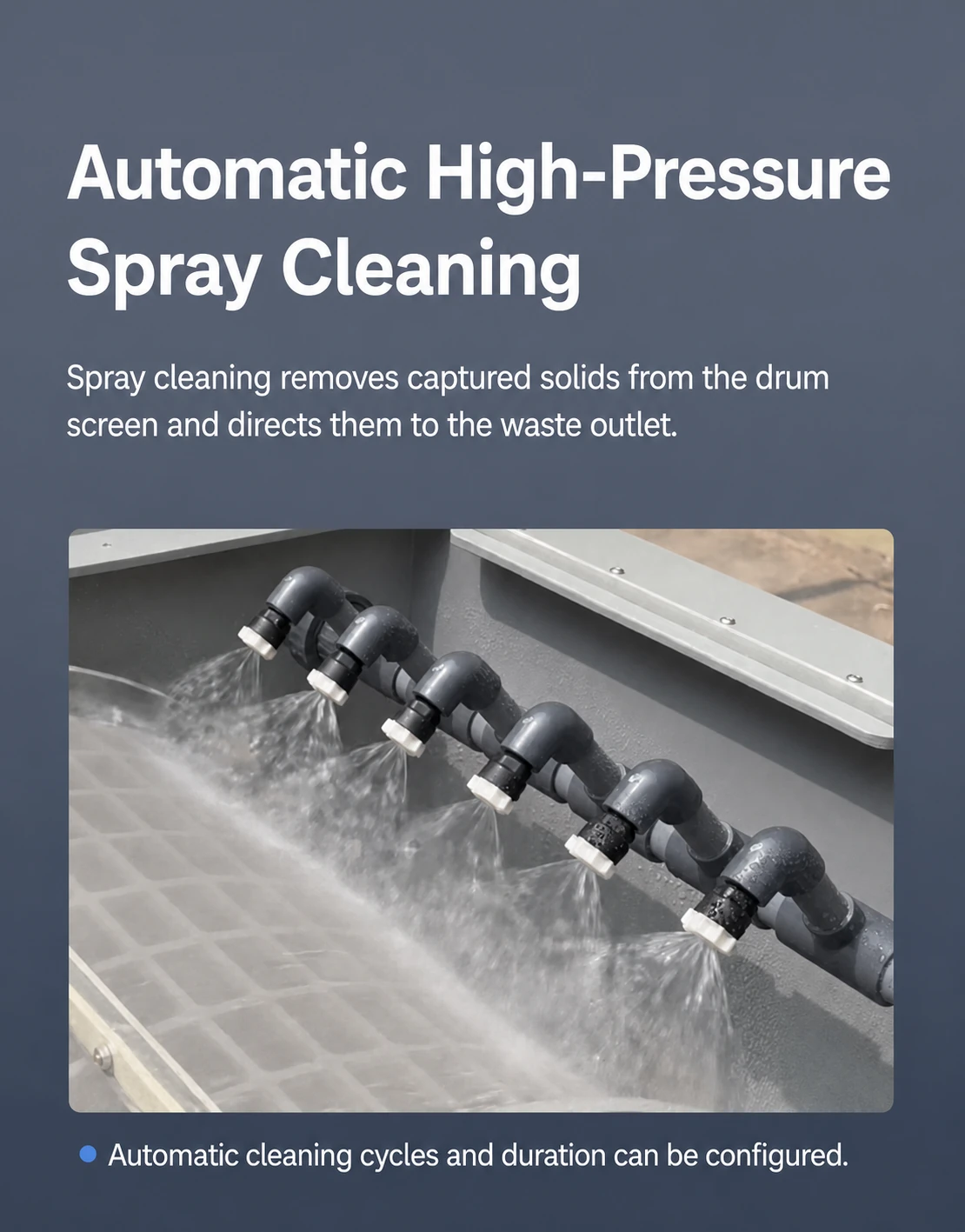
Automatic spray cleaning removes retained solids from the rotating screen.
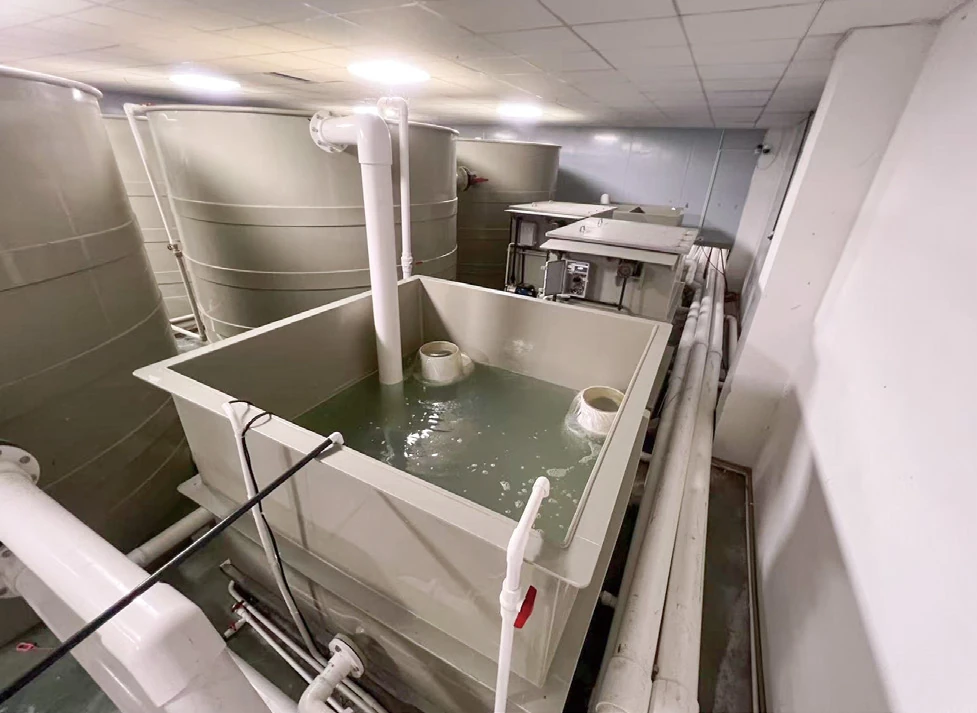
Reference filtration-room environment illustrating equipment access, pipe routing and surrounding treatment tanks.
Buyer factor 4
Factor 4: Gravity-Fed or Pump-Fed Hydraulic Arrangement
The drum filter must fit the actual water-level and pumping arrangement. A gravity-fed installation and a pump-fed installation can require different chamber levels, pipe routing and safeguards.
For a gravity-fed system, confirm the operating water level, available head and elevation relationship between tanks, filter and downstream equipment. Insufficient head or undersized pipework can limit actual flow even if the nominal model capacity appears adequate.
For a pump-fed system, confirm the pump duty point, inlet arrangement and how the system will respond if the screen becomes restricted or the cleaning cycle is interrupted. The design should also consider safe overflow or bypass behavior.
Provide a simple process drawing showing:
- Tank outlet level.
- Filter inlet and outlet levels.
- Pump location.
- Biofilter and oxygenation equipment.
- Return-water route.
- Bypass and overflow provisions.
This drawing often reveals integration problems that a specification table cannot show.
Buyer factor 5
Factor 5: Installation Space, Connections and Waste Discharge
A drum filter needs space not only for the cabinet, but also for operation and maintenance. Confirm the available length, width and height, along with doorways, access aisles and any lifting or removal restrictions.
Connection planning should cover:
- Inlet and outlet size, quantity and orientation.
- Connection type and regional pipe standard.
- Waste outlet route and discharge point.
- Cleaning-water inlet and required pressure.
- Drainage around the equipment.
- Clearance for opening covers and servicing the screen, motor, pump and nozzles.
The waste line deserves particular attention. Automatic cleaning only removes solids from the circulating water if the reject stream can leave the equipment freely. A poorly routed or undersized waste line can create operational problems.
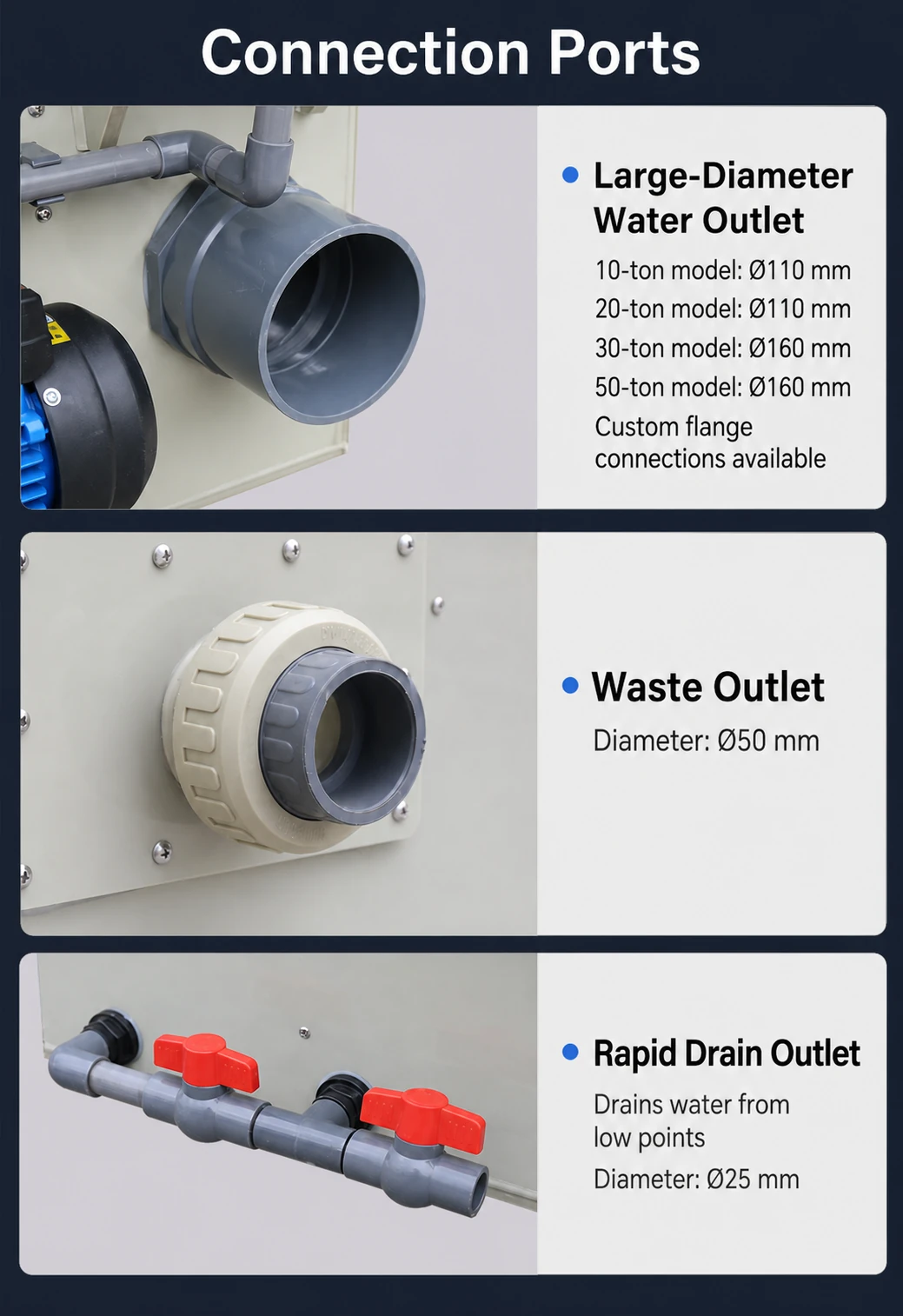
Connection details support early planning for pipework, drainage and equipment access.

Electrical and drive components must be matched to the installation environment and local power supply.
Buyer factor 6
Factor 6: Materials, Environment and Electrical Supply
The equipment environment affects component selection and service planning. Tell the supplier whether the unit will operate indoors, outdoors, in a humid filtration room or in a potentially corrosive environment. Also identify whether the water is fresh, brackish or saline.
Confirm:
- Water type and expected operating temperature.
- Indoor or outdoor location.
- Ambient moisture and ventilation.
- Local voltage, phase and frequency.
- Available cleaning-water supply.
- Control-system interface requirements.
Do not assume that a material suitable for one part of the filter is automatically suitable for the complete environment. Screen material, housing, fasteners, pump, motor, control enclosure and connections should be reviewed as a system.
For international orders, electrical details must be agreed before production. A quotation should clearly state the proposed power supply and included control components.
Buyer factor 7
Factor 7: Automatic Cleaning, Maintenance Access and Spare Parts
“Self-cleaning” reduces routine manual screen washing, but it does not mean maintenance-free. Buyers should evaluate how the cleaning cycle is triggered, what components require inspection and how quickly routine service can be performed.
Ask the supplier:
- What triggers drum rotation and spray cleaning?
- Is a wash pump included in the offered configuration?
- How are nozzles inspected and cleaned?
- How can the screen be accessed?
- Which wear or service parts should be kept on site?
- What troubleshooting documents are provided?
- What information is needed when ordering replacement parts?
The approved product diagram below identifies the screen, spray nozzles, drum-drive motor, control box, water outlet, high-pressure pump and drain outlet. These are not just product features; they are maintenance and spare-parts planning points.
Maintenance access should be considered during layout design. A filter positioned tightly against walls or crowded by pipes may be inexpensive to install initially but costly to service later.
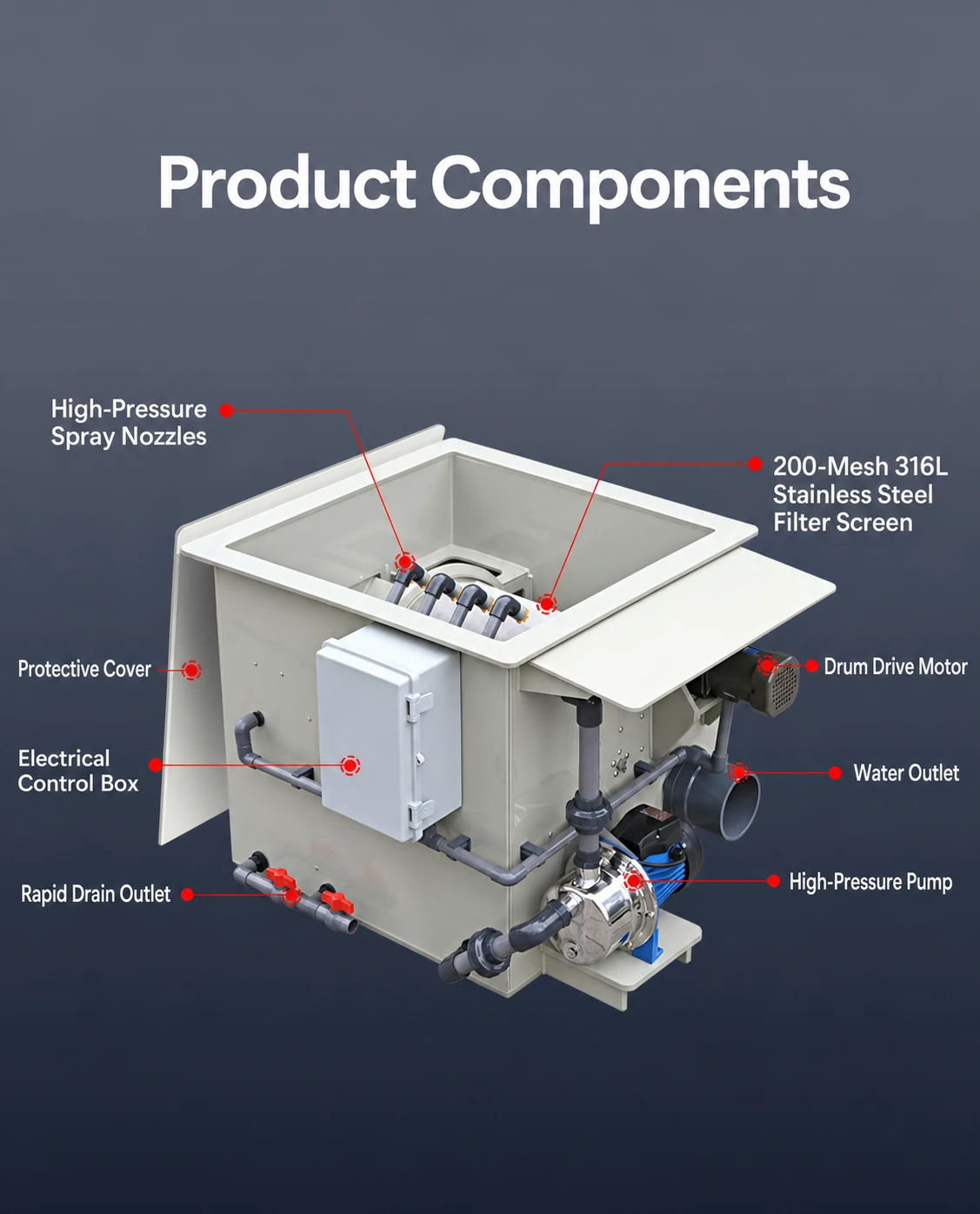
Main components to review during technical evaluation and maintenance planning.
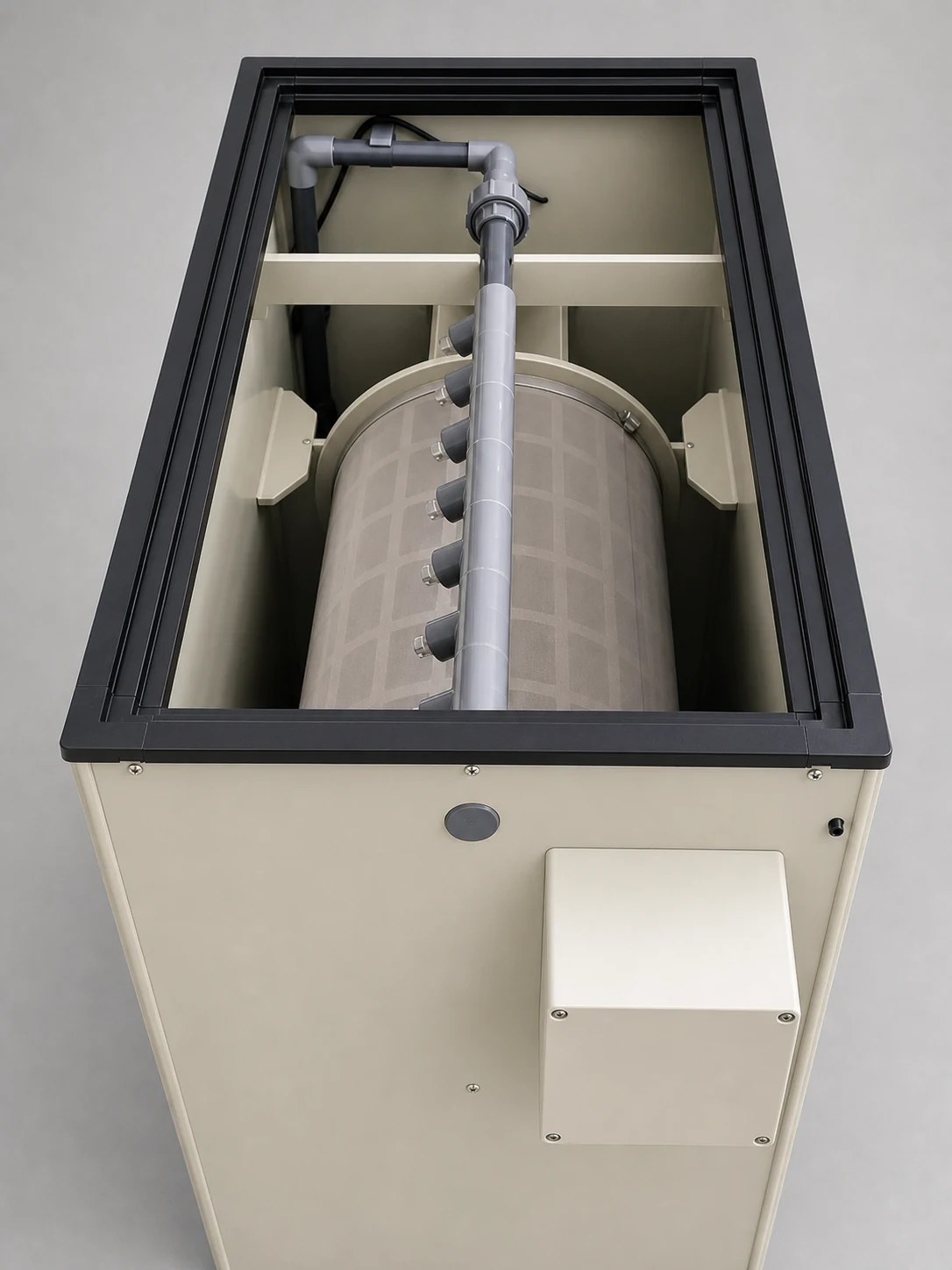
Open-chamber view of the screen and spray pipe used for automatic mechanical filtration.
Buyer factor 8
Factor 8: RAS Integration, Redundancy and Future Expansion
The final factor is the system around the filter. A drum filter is one part of a treatment train, so its selection should support downstream equipment and the farm’s operating strategy.
Review:
- How filtered water reaches the biofilter.
- Whether the downstream stage requires a stable water level.
- What happens during cleaning or equipment maintenance.
- Whether one filter serves the full facility or separate production zones.
- Whether standby capacity or bypass is required.
- Whether future tanks will increase flow or solids load.
Facilities with sensitive stock or continuous production may place a higher value on redundancy and serviceability than on the lowest initial purchase price. In some projects, separate filtration lines reduce the consequence of maintenance on one unit. In others, space or budget may favor centralized treatment. This is a system-design decision for the buyer and integrator.
Pre-quotation preparation
Prepare the technical basis before comparing offers
Drum Filter Selection Checklist
Use this checklist before comparing models or requesting prices.
| Decision area | Information to provide |
|---|---|
| Application | Hatchery, nursery, grow-out, holding, shrimp or other |
| Species and production | Species, production stage, current and maximum biomass |
| Hydraulic duty | Design flow, peak flow, turnover basis and number of lines |
| Solids duty | Feed input, feeding pattern and known solids concerns |
| Water | Fresh, brackish or saline; expected temperature |
| Screen objective | Target solids-removal duty and downstream treatment needs |
| Installation | Gravity- or pump-fed, operating water levels, available head |
| Space | Equipment footprint, access aisle, doorway and service clearance |
| Connections | Inlet, outlet, waste and cleaning-water requirements |
| Electrical | Voltage, phase, frequency and control interface |
| Operations | Maintenance plan, spares, bypass and redundancy |
| Commercial | Quantity, delivery country and required schedule |
If several items are unknown, send a process sketch and explain the planned production system. The supplier can identify which missing inputs must be confirmed before final model selection.
Technical Questions to Ask Before Quotation
Use the following questions to make quotations easier to compare:
- Which operating data was used to select the proposed model?
- What screen specification is included?
- What inlet, outlet and waste connections are proposed?
- Is the wash pump included, and what water supply is required?
- What electrical supply and control configuration are included?
- What installation water levels or available head are required?
- What routine inspection and maintenance tasks are recommended?
- Which spare parts should be ordered with the equipment?
- What drawings and installation documents will be supplied?
- Which project conditions could reduce actual capacity?
A useful quotation should make the technical basis visible. If two offers use different assumptions, their prices are not directly comparable.
Risk control
Common Purchasing Mistakes
Selecting only by tank volume
Tank volume without turnover, flow, biomass and feed information does not describe the full duty.
Treating nominal capacity as guaranteed project flow
Actual performance depends on screen, water level, solids load and hydraulic arrangement. Ask for confirmation against the project conditions.
Choosing the finest screen without discussing cleaning load
Finer separation can increase restriction and cleaning frequency. Define the separation objective first.
Ignoring waste and cleaning-water connections
The wash system needs a suitable supply, and separated solids need an unrestricted discharge route.
Comparing equipment without comparing scope
Check whether the pump, control box, screen, connections, documentation and spares are included in each offer.
Leaving maintenance access until installation
Service clearance should be designed before pipework and walls make access difficult.
Forgetting local electrical requirements
Voltage, phase and frequency must be confirmed before production, especially for export projects.
Mixing residential pond and commercial RAS criteria
A commercial fish farm has different operating, integration and risk requirements from a backyard pond. Use aquaculture-specific project data.
Buyer FAQ
Frequently Asked Questions
What information is needed to size a drum filter for a fish farm?
Provide design and peak flow, species, production stage, maximum biomass, feed input, water type, screen objective, hydraulic layout, installation space, connections and electrical supply. Tank volume alone is insufficient.
How often does an aquaculture drum filter clean itself?
Cleaning frequency depends on solids loading, screen condition, flow and the control method. Automatic systems typically start cleaning in response to a water-level difference or control setting. The supplier should confirm the control logic for the offered model.
Can a drum filter be integrated into an existing RAS?
Often yes, but integration must be reviewed. Provide current process flow, pipe sizes, operating water levels, pump details, available space and downstream equipment information before selecting the unit.
What mesh size should I choose?
Choose according to the solids-removal objective, hydraulic duty and cleaning demand. A finer screen is not always better. Confirm the offered screen and expected operating conditions with the supplier.
Does a self-cleaning drum filter require maintenance?
Yes. Automatic cleaning reduces routine manual washing, but the screen, spray nozzles, pump, motor, controls, seals, waste line and connections still require inspection and preventive maintenance.
What should an international buyer confirm about shipping and support?
Confirm packing method, delivery terms, destination, lead time, document scope, installation guidance, spare-parts recommendations and the technical contact process. Also verify local electrical compatibility before production.
Project-based model review
Request Technical Review
If you are planning a fish farm, hatchery or RAS project, Jiangxi Pursun Tech Co.,Ltd. can review the mechanical-filtration requirement and prepare a model recommendation based on the information you provide.
Send:
- Application and fish species.
- Tank volume and number of tanks.
- Design and peak flow requirement.
- Current or planned filtration process.
- Biomass and feed information, if available.
- Installation drawing, available space and operating water levels.
- Country, power supply, quantity and target schedule.
Request a Technical Review or review the aquaculture drum filter product range before preparing your inquiry.
A recommendation is only as reliable as the project data supplied. Final model selection should be confirmed against the approved quotation, drawing and technical specification.