
Commercial aquaculture mechanical filtration
Aquaculture Drum Filter for Commercial Fish Farms and RAS Systems
Pursun aquaculture drum filter equipment removes suspended solids from fish-farm and commercial aquaculture water before it reaches biological treatment. This page covers the equipment-level mechanical filtration stage, not complete RAS system design.
Provide your species, tank volume, design flow and installation conditions for a project-based model review.
- Remove suspended solids before downstream biological treatment
- Use an automatic cleaning cycle for continuous mechanical filtration
- Review model selection against real hydraulic and installation data
Fish farms · Hatcheries · RAS integrators · Aquaculture distributors
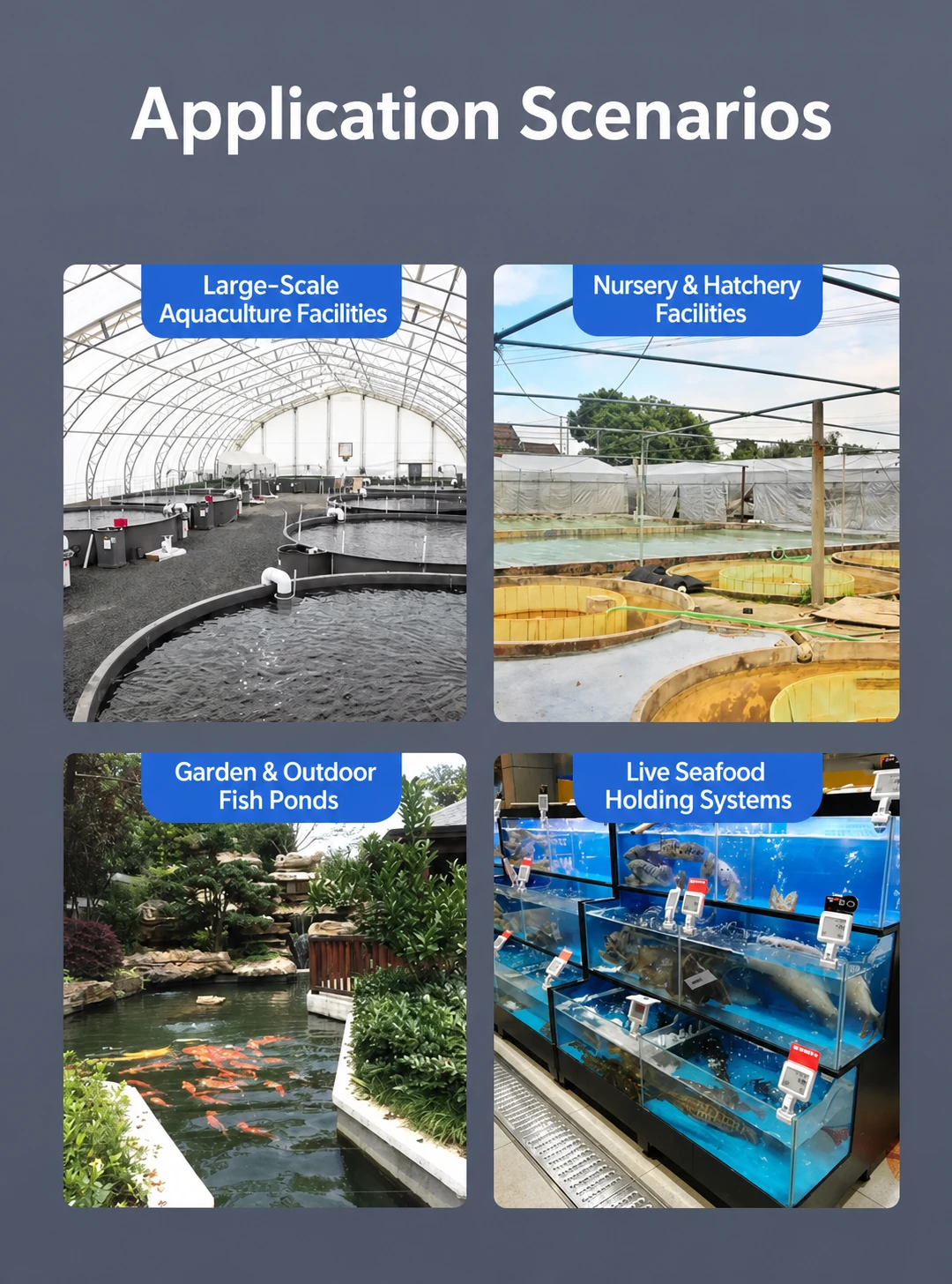
Commercial aquaculture operating challenges
Managing suspended solids is critical in modern aquaculture systems
Fish waste, uneaten feed and other suspended particles must be separated from the recirculating-water path before they add unnecessary load to downstream treatment equipment.
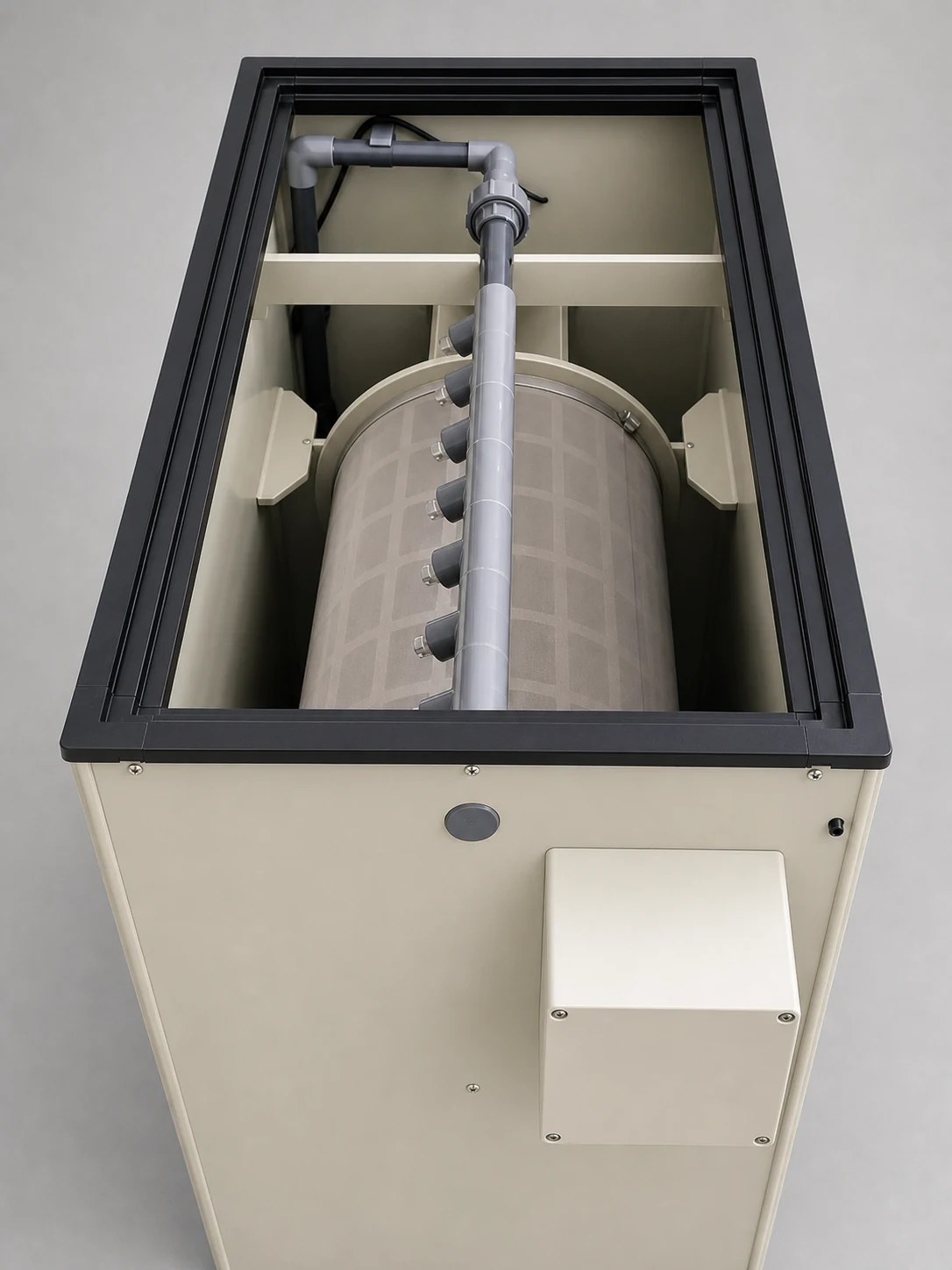
01
Suspended solids remain in circulation
Particulate waste from culture tanks can continue through pipework and treatment stages unless a suitable mechanical separation step is installed.
02
Manual screen cleaning increases workload
Repeated manual cleaning interrupts routine operation and makes solids-removal performance dependent on operator availability.
03
Downstream treatment receives avoidable solids
Uneaten feed, fish waste and other particles can increase deposits and particulate organic loading before biological treatment.
04
Integration conditions vary by project
Flow, operating water level, gravity- or pump-fed layout, pipework, waste discharge and maintenance access all affect equipment selection.
05
Production load changes over time
Species, life stage, biomass and feeding conditions change the expected solids load, so model review must consider both current and planned operation.
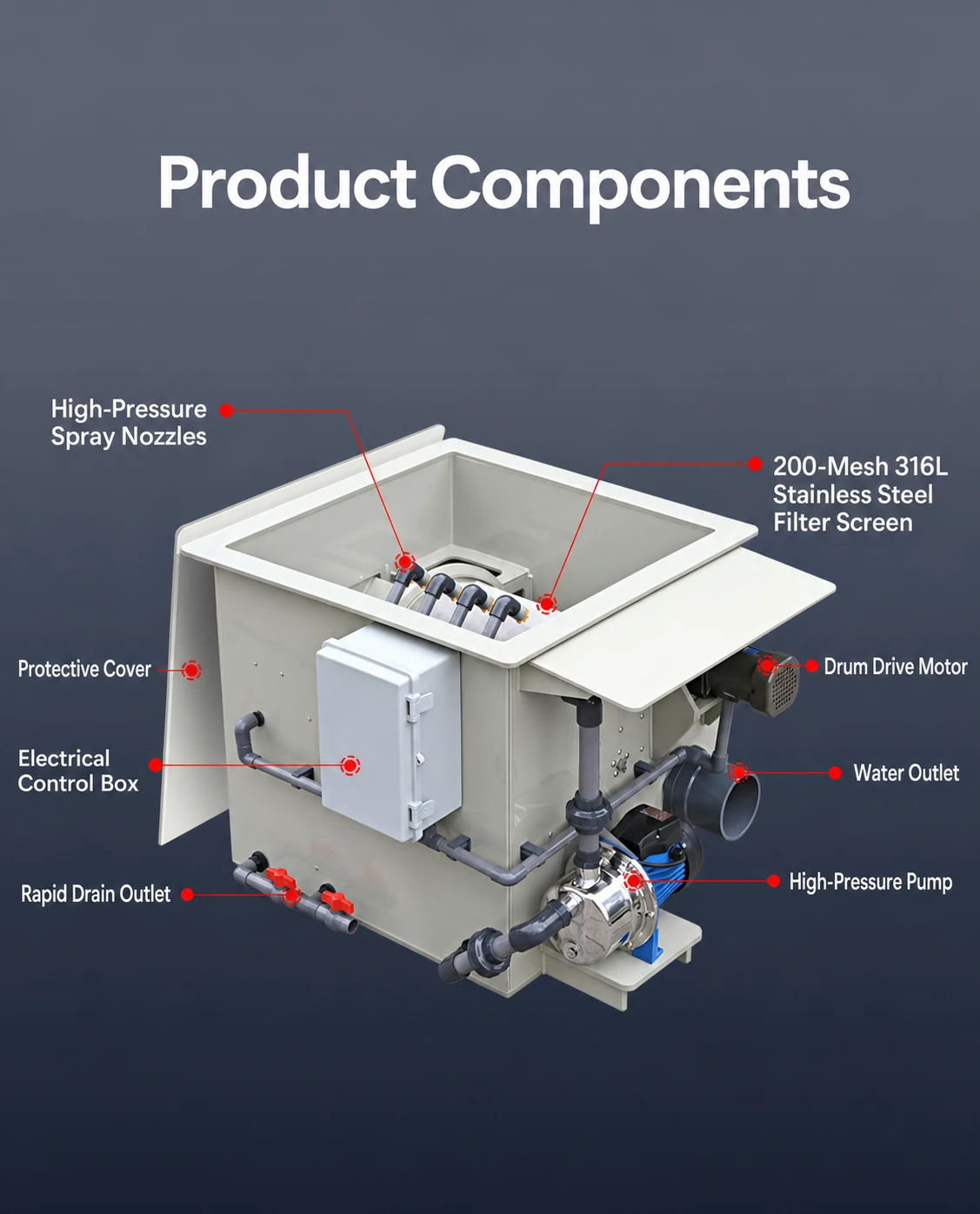
Aquaculture and RAS treatment workflow
Where the drum filter fits in the water-treatment process
The drum filter is the first-stage mechanical filtration unit in this simplified treatment train. It removes particulate solids before biofiltration; biological treatment, oxygen management and system hydraulics remain separate engineering stages.
For the complete engineering context, review the RAS filtration system. For the broader equipment family, see our drum filter range.
01 · Fish Tank
Culture water carries fish waste, uneaten feed and suspended particles away from the production tanks.
↓
02 · Mechanical Filtration (Drum Filter)
Water passes through the screened drum. Captured solids are removed through the automatic cleaning and waste-discharge process.
↓
03 · Biofiltration
Biological treatment converts dissolved ammonia through nitrification. Mechanical pretreatment reduces the particulate load reaching this stage.
↓
04 · Oxygenation
Aeration or oxygenation restores the oxygen required by the cultured species and biological processes according to system design.
↓
05 · Return Water
Treated water returns to the culture tanks through the designed pumps, pipework and distribution system.
Application suitability depends on flow, species, biomass, feeding conditions, hydraulic layout and downstream treatment requirements.
Commercial aquaculture applications
Mechanical filtration for different production and project requirements
The drum filter should be reviewed as one stage in the complete water-treatment system. Each buyer type has different solids loads, integration requirements and purchasing priorities.
Commercial Fish Farms
Problem: Fish waste and uneaten feed create ongoing particulate loads.
Mechanical filtration role: Separate suspended solids from the circulation loop before downstream treatment.
Hatcheries
Problem: Broodstock, fry and fingerling systems can have fine and changing solids loads.
Mechanical filtration role: Provide continuous solids capture matched to life stage, tank groups and design flow.
Grow-out Systems
Problem: Increasing biomass and feed input change the expected waste load.
Mechanical filtration role: Remove particulate waste using a screened, automatically cleaned mechanical stage.
Indoor Aquaculture Facilities
Problem: Limited equipment-room space and controlled production routines require planned integration.
Mechanical filtration role: Fit solids removal into the available footprint, water levels, pipework and service access.
RAS Projects
Problem: Particulate solids can add load to biofilters and other treatment equipment.
Mechanical filtration role: Protect downstream stages by separating solids at the front of the treatment train.
Aquaculture Distributors
Problem: Incomplete project data creates model-selection and quotation risk.
Pursun support: Review application inputs and confirm the proposed configuration, connections and documentation with the quotation.
Pursun aquaculture drum filter solution
Automatic mechanical solids separation for continuous aquaculture operation
The product solution combines screened solids capture, automatic cleaning and controlled waste discharge in one mechanical filtration stage. Final model and connection details are confirmed from project data.
01
Rotary drum screen
Culture water passes through the filtration surface while suspended particles are retained on the screen.
02
Automatic cleaning system
A configured cleaning cycle rotates and sprays the loaded screen area to restore available filtration surface.
03
Waste discharge path
Removed solids and wash water are directed toward a defined waste outlet for connection to the project sludge-handling route.
04
Continuous mechanical filtration
Filtration continues as part of the circulating system while the automatic cleaning process reduces repeated manual screen handling.
05
RAS integration
Inlet, filtered-water outlet, waste, drain, power and control interfaces are reviewed against the complete hydraulic layout.
Verified product technology
Technical features explained for aquaculture system integration
These verified components support mechanical solids capture, automatic cleaning and project integration. Model-specific dimensions, screen specification, motor, controls and connections are confirmed with the quotation.
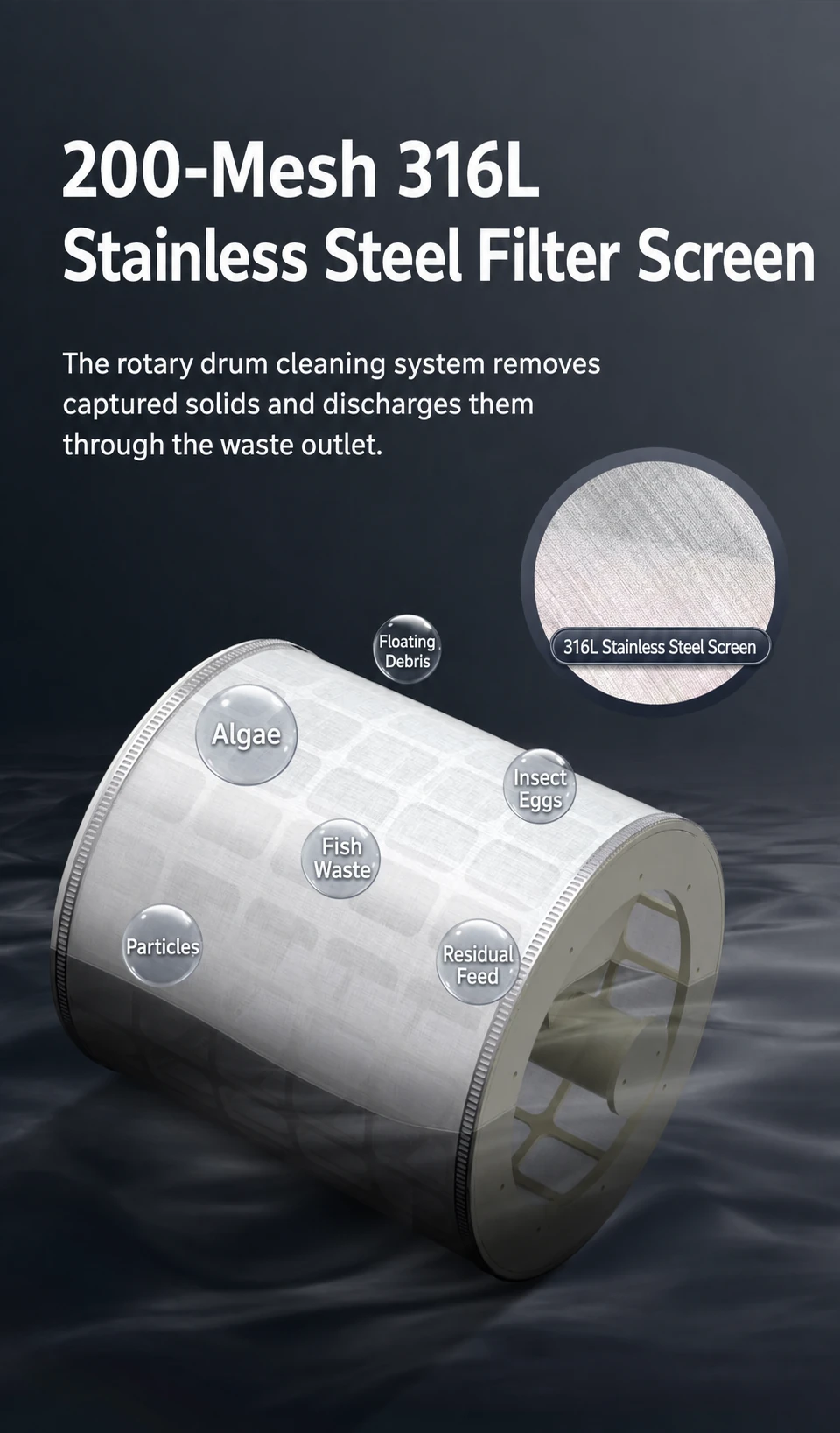
01 · 316L stainless-steel screen
Mechanical filtration media before biological treatment
The 316L stainless-steel filtration surface captures suspended solids before water enters downstream treatment. Confirm the screen specification against flow, particle objective, water type and selected model.
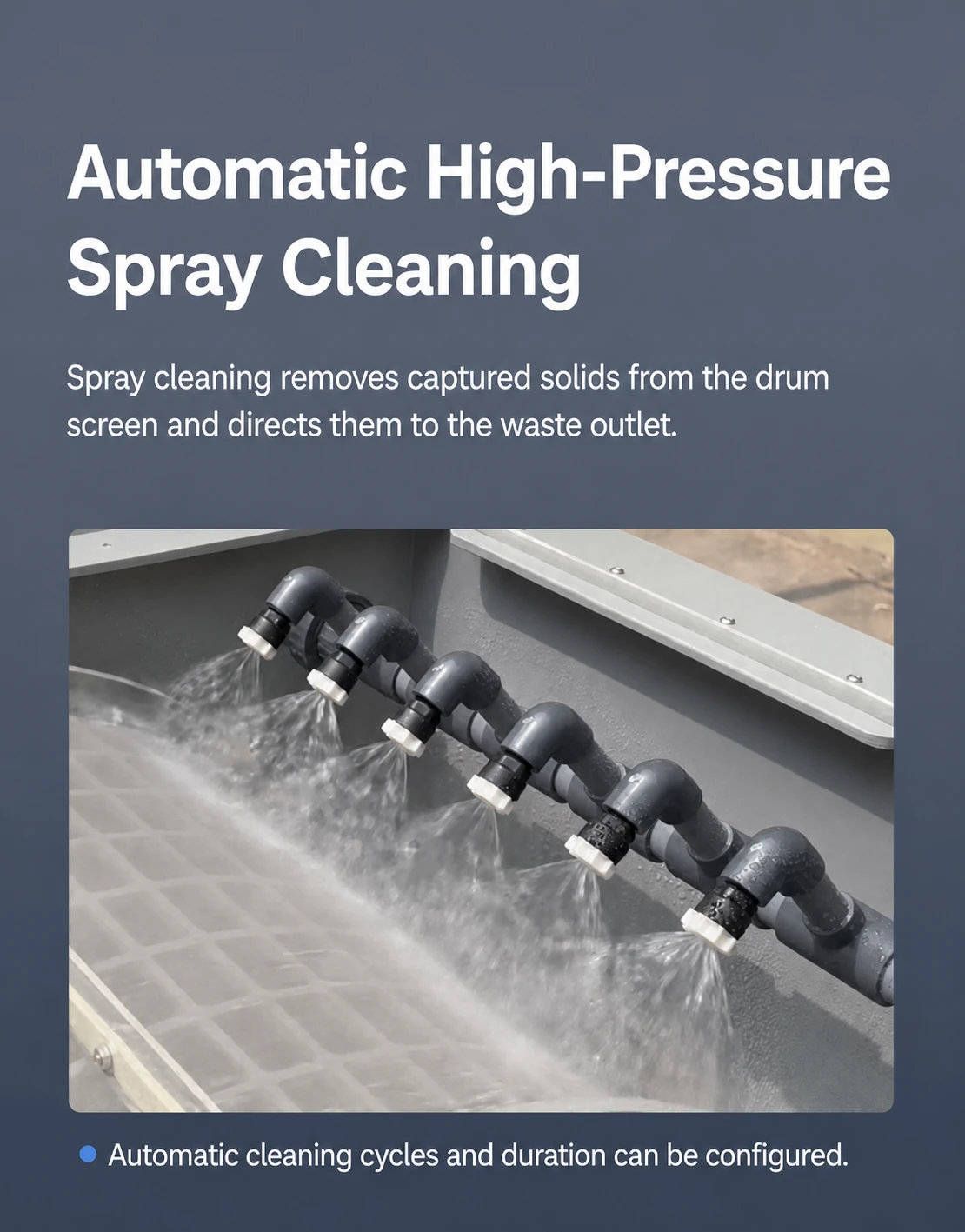
02 · Automatic spray cleaning
Remove retained solids and restore available screen area
The spray system removes trapped particles from the rotating screen and directs the wash stream toward the waste outlet. Nozzles and the waste route remain part of routine inspection.

03 · Drive motor
Rotate the drum during the configured cleaning process
The geared drive motor rotates the drum during cleaning. Motor details and destination electrical supply are confirmed for the selected configuration.
04 · Control system
Coordinate the cleaning cycle and connected components
The control arrangement coordinates the motor, cleaning process and configured sensing components. Available controls and electrical details depend on the selected model and order scope.
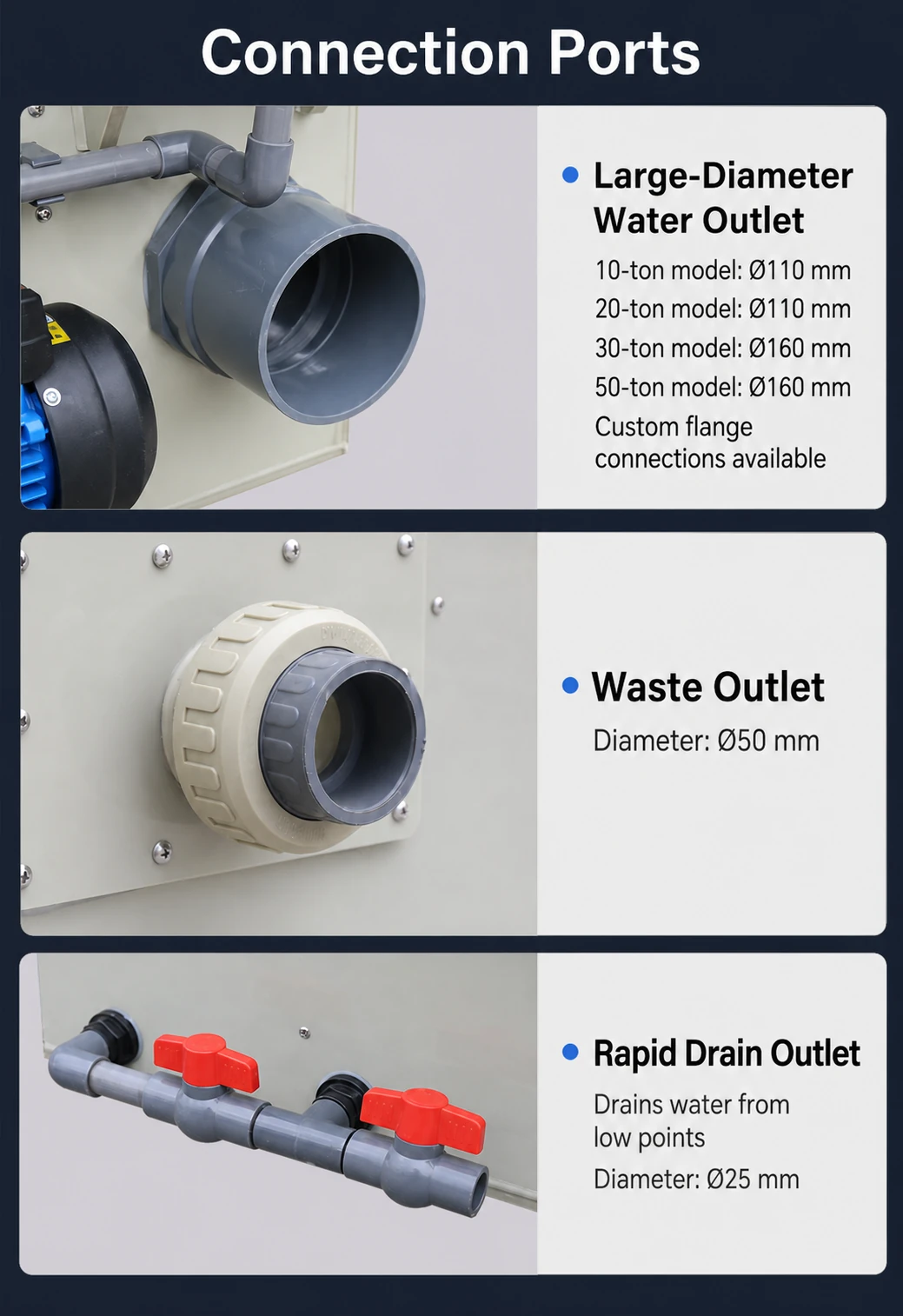
05 · Connection options
Match the filter interfaces to the project hydraulic layout
Inlet, filtered-water outlet, waste, drain and optional connection arrangements must match water levels, pipework and the maintenance plan. Sizes and inclusions vary by model.
Model selection and project review
Flow Rate and Screen Mesh Selection for an Aquaculture Drum Filter
Model selection begins with design flow, normal and peak operating conditions, expected solids load, screen-mesh objective, hydraulic layout and service access. Use the aquaculture drum filter selection guide to review these inputs before technical evaluation, then provide a process diagram, equipment-room layout and existing-system photos for the project review.
Selection input
Fish species and life stage
Project detail to provide
Identify the cultured species and whether the system serves eggs or larvae, fry, juveniles, grow-out, broodstock or live holding.
Selection input
Tank volume and tank quantity
Project detail to provide
Provide individual tank volume, total system volume and the number of tanks connected to the treatment loop.
Selection input
Required flow rate
Project detail to provide
State the design flow and, where applicable, normal and peak operating flow. Do not estimate the filter solely from tank volume.
Selection input
Biomass and feeding conditions
Project detail to provide
Provide current and maximum biomass plus feed information when available so expected solids loading can be reviewed.
Selection input
Installation space and hydraulics
Project detail to provide
Provide footprint, service clearance, water levels, gravity- or pump-fed layout, pipe sizes and the waste-discharge route.
Selection input
Power supply
Project detail to provide
Confirm destination voltage, phase and frequency for the motor, wash pump and control arrangement.
Also include: current filtration system, water type, country, quantity, project schedule and drawings. Final screen, dimensions, connections, construction, motor, wash pump, electrical arrangement and included components are confirmed in the quotation.
Aquaculture and RAS buyer FAQ
Questions to resolve before technical selection and quotation
Commercial aquaculture project inquiry
Request a technical review for your filtration project
Jiangxi Pursun Tech Co.,Ltd. reviews application, species, life stage, tank volume, design flow, biomass, hydraulic layout, installation requirements and destination before discussing a suitable drum filter direction.
- Company: Jiangxi Pursun Tech Co.,Ltd.
- WhatsApp: +86 13922335519
- Helpful details: flow, application, fish load, layout, pipe sizes, power, quantity and destination
Send Your Project Details
Complete the project fields below. Include a process diagram, equipment-room layout or existing-system photos when available in your follow-up communication.