
What Is a Rotary Drum Filter? Complete Guide for Pond and Aquaculture Filtration
Suspended solids are one of the first problems that filtration equipment must control. In a koi pond, they can include fish waste, uneaten feed, algae fragments, and debris carried into the water. In a commercial aquaculture system, the same types of particles may circulate through tanks and place additional solids load on downstream treatment.
A rotary drum filter provides automatic mechanical separation. Water passes through a screened rotating drum, suspended particles remain on the screen, and a cleaning system removes the retained material to a waste outlet. The equipment is used in pond filtration as well as professional aquaculture and recirculating aquaculture systems, but model selection and system design are different for each market.
This guide explains how rotary drum filtration works, where it fits in a water-treatment process, what benefits buyers can reasonably expect, and what information is needed before choosing a model.
For product specifications and model data, review the automatic rotary drum filter range. Pond buyers can also compare the complete pond filtration system route and the dedicated koi pond drum filter application page.
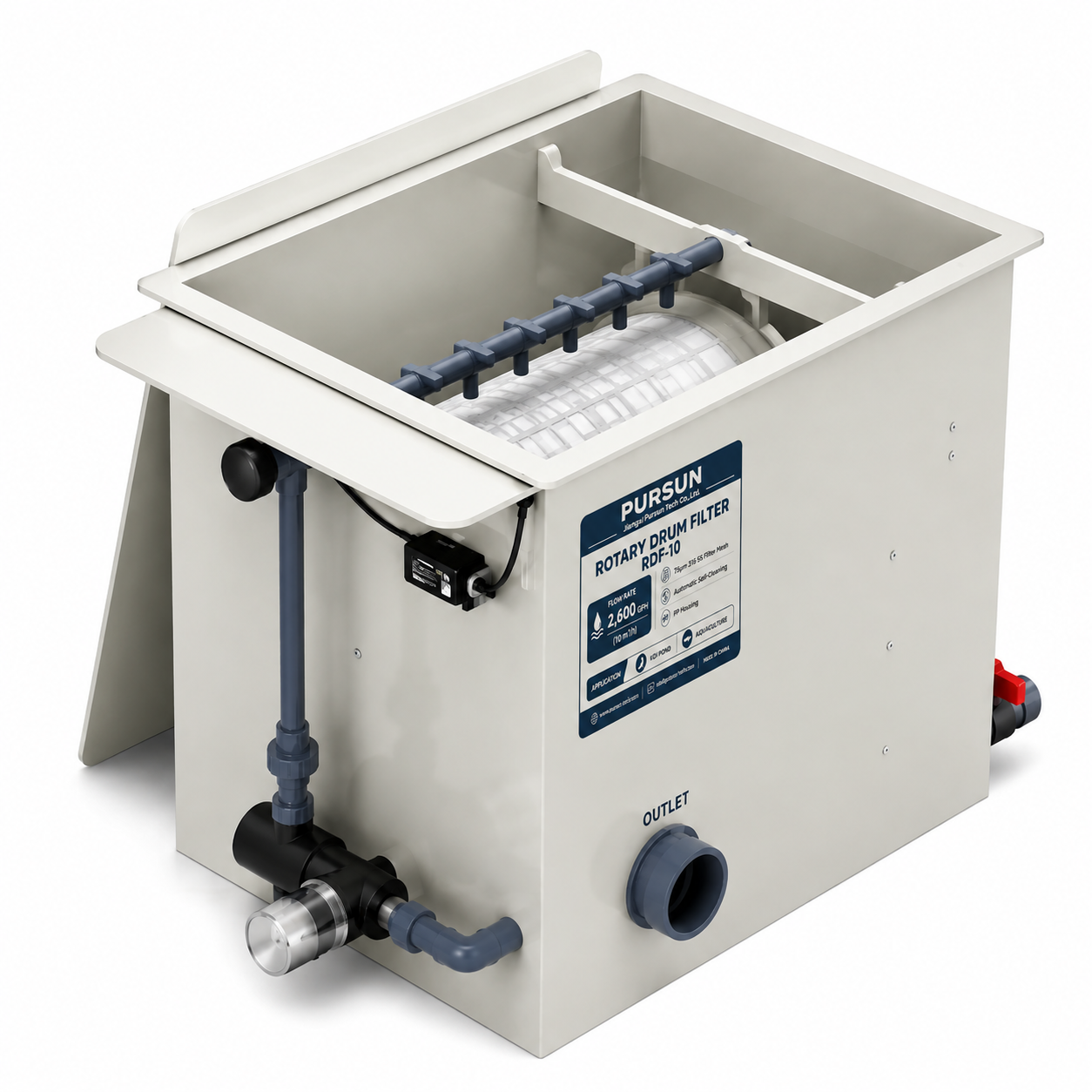
Automatic rotary drum filter configured for mechanical solids separation.
What Is a Drum Filter?
A drum filter is a mechanical filtration unit built around a cylindrical screen. The screen allows water to pass while retaining suspended particles that are larger than the selected screen opening. As solids accumulate, the screen becomes increasingly loaded. A controller then activates drum rotation and spray cleaning so that the collected waste can leave through a separate sewage or waste outlet.
This process makes a drum filter different from a static screen, filter brush, or manually cleaned filter pad. The screen remains part of an automated operating cycle rather than waiting for the operator to remove and wash the media after every loading event.
The core equipment normally includes:
- A rotating drum and supporting structure
- A fine filter screen
- Water inlet and filtered-water outlet connections
- A waste-collection channel and sewage outlet
- A drum drive motor
- A spray-cleaning system
- A controller and cleaning trigger
The exact screen option, hydraulic flow, operating water level, cleaning pressure, and electrical configuration must be confirmed for the selected product and project. A model name alone should not be treated as a verified flow rating.
Mechanical filtration, not complete water treatment
A rotary drum filter removes suspended solids. It does not perform every water-treatment function.
For a koi pond, biological filtration may still be required to manage dissolved nitrogen waste. Circulation pumps, UV treatment, aeration, and other components may also be needed according to the pond design.
For aquaculture and RAS applications, the drum filter is normally positioned before biological filtration. Biofilters, oxygenation, disinfection, monitoring, pumps, and backup systems remain separate treatment functions.
Understanding this boundary is important. A drum filter can reduce the particulate load entering downstream treatment, but it should not be described as a complete pond or RAS filtration system by itself.
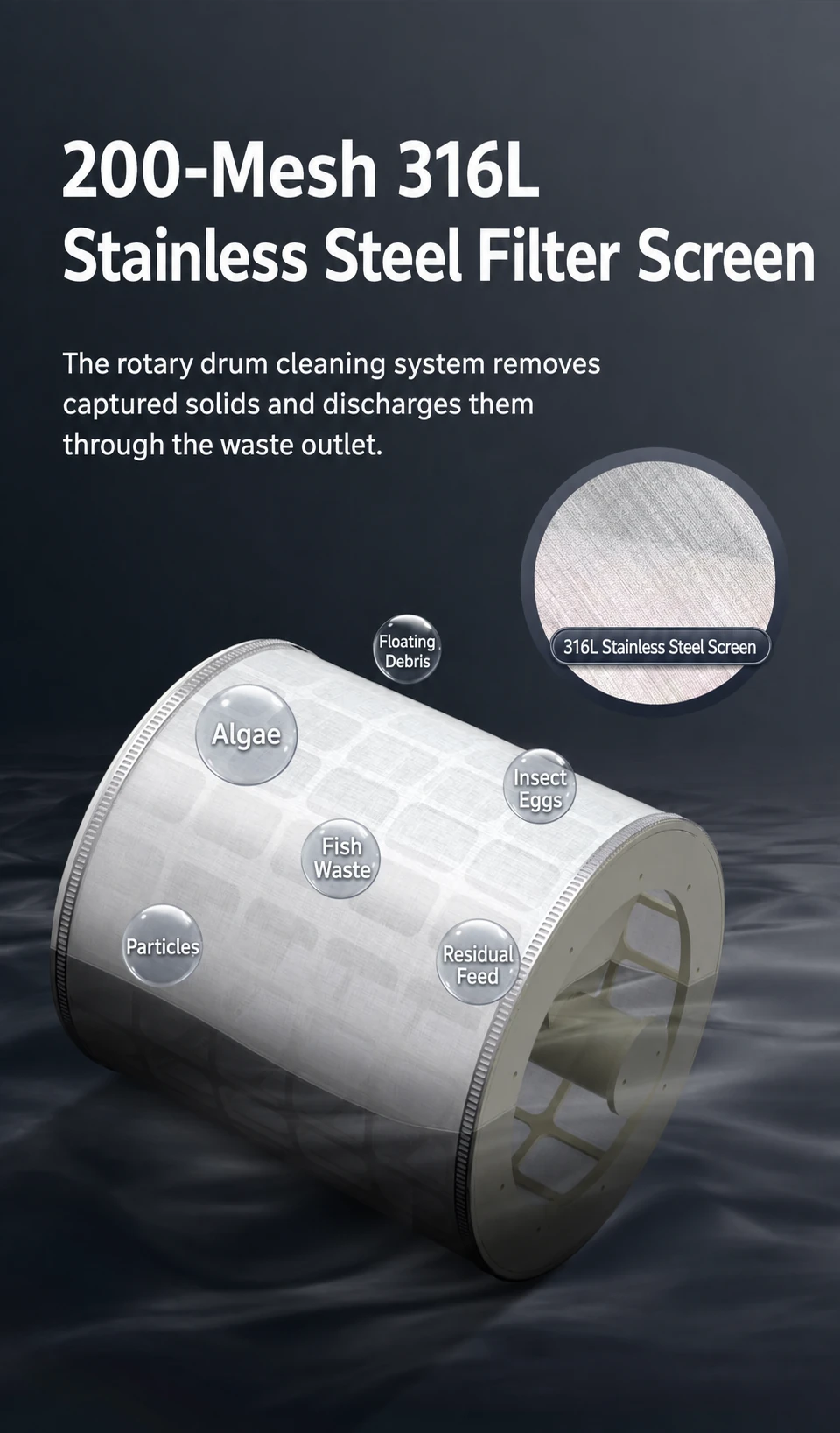
Screen media performs the physical separation stage; the approved screen option must be confirmed for each model.
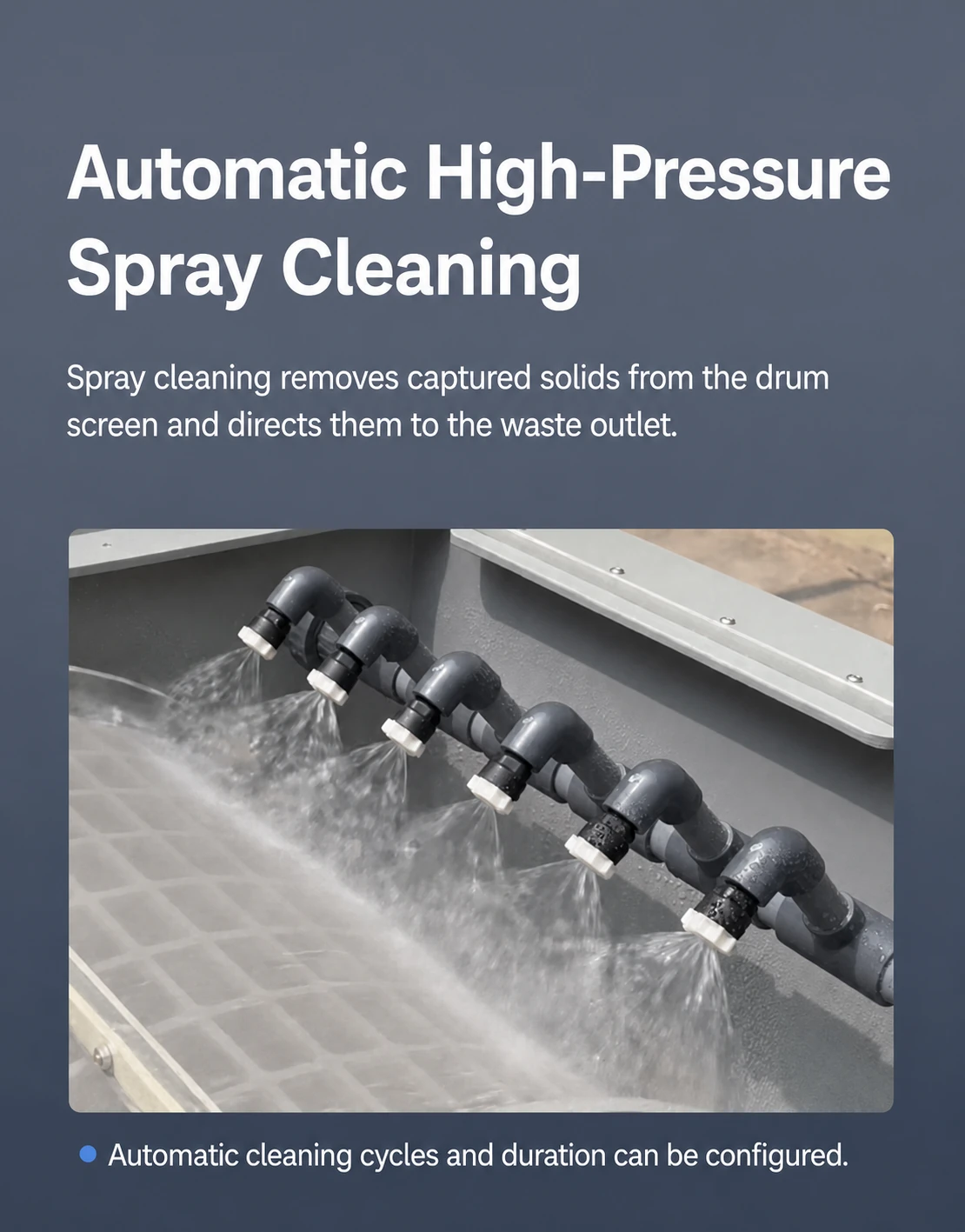
Spray cleaning removes retained solids from the rotating screen and directs them toward the waste channel.
How Does a Rotary Drum Filter Work?
Although the details vary by product configuration, the basic filtration sequence is straightforward.
1. Water enters the drum-filter chamber
Water from the pond, fish tank, or circulation line enters the filter housing. The installation may be gravity-fed or pump-fed depending on the hydraulic design. Operating water level and connection orientation must match the selected equipment.
2. Water passes through the screen
The water moves through the drum screen while suspended solids remain on the screen surface. The screen performs physical separation; it does not dissolve or biologically convert the waste.
3. Solids loading creates a cleaning trigger
As material accumulates, resistance across the screen increases. Many systems use a water-level difference or another control condition to initiate cleaning. Exact trigger thresholds and control logic are model-specific and should be confirmed before ordering.
4. The drum rotates
The controller starts the drive motor, rotating the loaded screen toward the spray-cleaning area. Filtration can continue while the cleaning sequence operates when the equipment and hydraulic layout are correctly configured.
5. Spray water removes retained solids
Spray nozzles direct cleaning water onto the screen. The removed solids fall into a waste channel rather than returning to the filtered-water side. Cleaning pressure, water consumption, and cycle duration should come from approved technical data, not estimates based only on pump power.
6. Waste leaves through the sewage outlet
The concentrated solids discharge through the waste connection. The waste line needs sufficient fall, access, and capacity to avoid restriction or backflow.
7. Mechanically filtered water continues downstream
In a pond system, the water may continue to biological filtration or return circulation. In aquaculture, it normally continues to biofiltration and other treatment stages before returning to the culture tanks.
This automatic sequence is the basis of a self cleaning drum filter. “Self-cleaning” reduces frequent manual screen washing, but it does not mean maintenance-free. Operators still need to inspect the screen, spray nozzles, waste line, motor, controller, seals, and cleaning-water system.
Why Choose a Drum Filter for Pond Filtration?
Pond owners and installers commonly evaluate drum filters when manual mechanical filtration is taking too much time or when suspended solids need to be removed more consistently.
Reduced routine screen cleaning
The automatic cleaning cycle removes retained waste without requiring the operator to take out filter pads or brushes after every loading event. Routine inspection remains necessary, but the day-to-day maintenance pattern can be easier to manage.
Separation of waste from the circulation loop
Captured particles are directed to a sewage outlet. This is different from leaving the solids trapped in submerged media where they remain in contact with circulating water until the next manual service.
Continuous mechanical-filtration role
A rotary drum filter is designed to repeat the solids-capture and cleaning sequence during operation. This makes it suitable for ponds where feed, fish activity, seasonal debris, and algae fragments create changing solids loads.
Compact equipment options
Pond drum filters are available in compact housings suitable for residential installations. However, buyers should verify the full installation envelope, cover access, pipe orientation, operating water level, and maintenance clearance before choosing a model.
Clearer system responsibility
Using a dedicated mechanical-filtration stage makes it easier to separate solids-removal requirements from biological treatment. This helps pond builders plan the filtration train rather than expecting one component to perform every task.
For residential applications, see Pursun’s Koi Pond Drum Filter page. It keeps pond-specific sizing, installation, and maintenance questions separate from commercial aquaculture requirements.
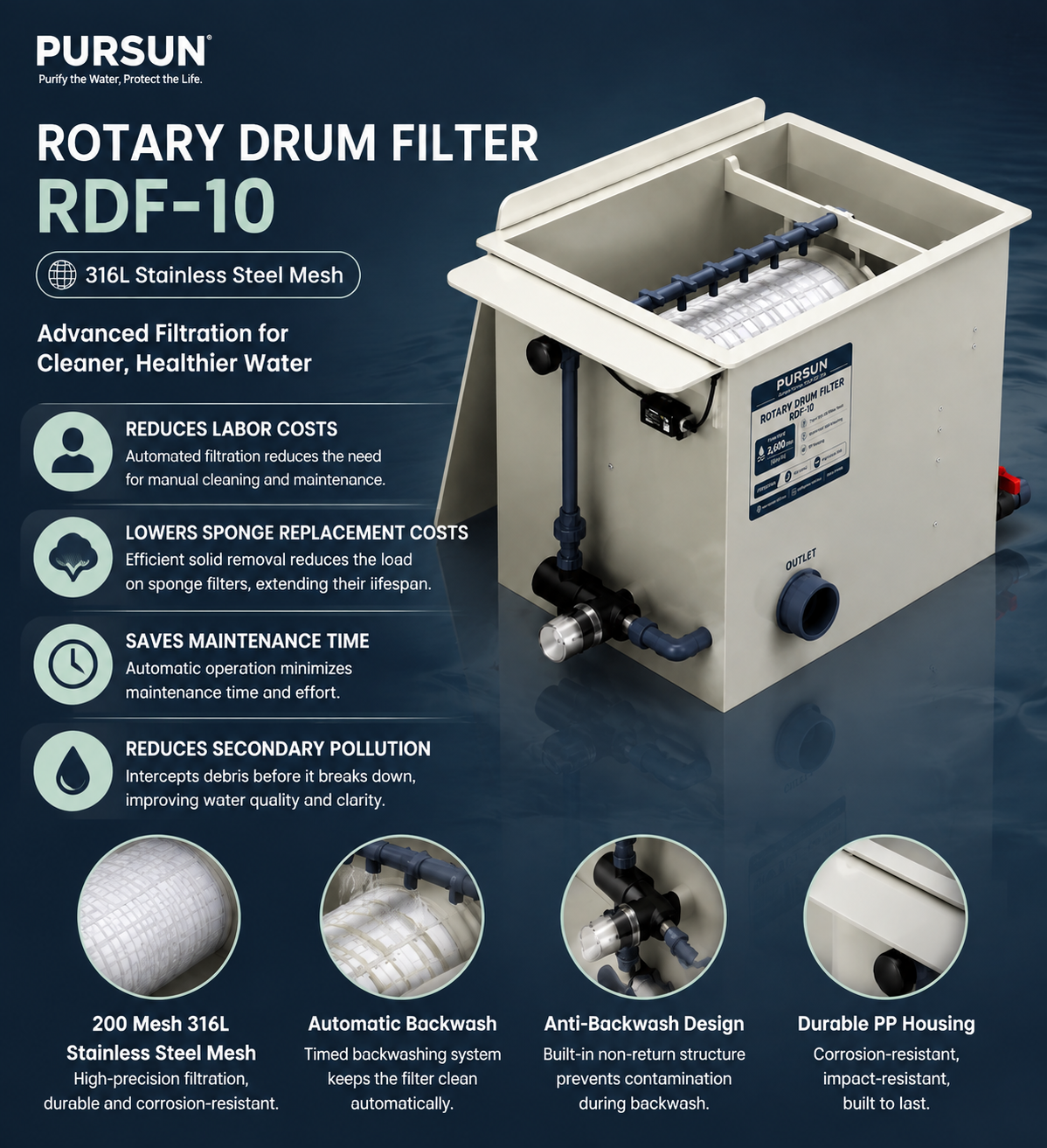
A pond-specific installation should be evaluated separately from commercial aquaculture requirements.
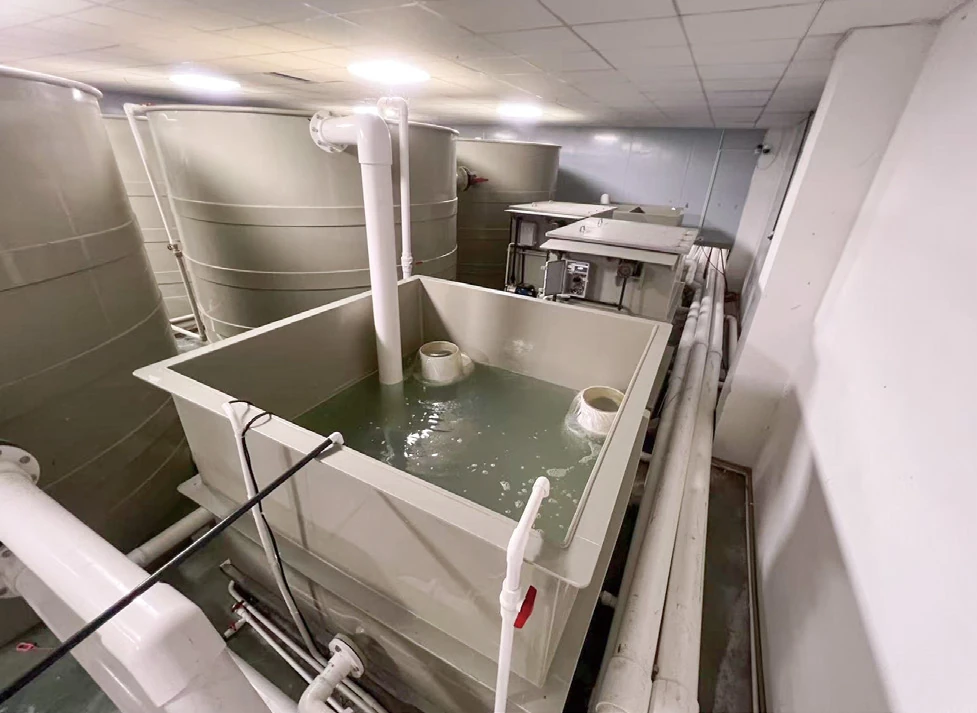
Commercial aquaculture filtration environment with treatment tanks and connected pipework.
Drum Filter Applications
Rotary drum filtration is used across different water-treatment markets, but the same sales message should not be applied to every customer.
Koi ponds
In koi ponds, a drum filter removes suspended solids before the water continues to biological treatment or return circulation. Buyers typically care about water clarity, reduced manual cleaning, installation space, noise, waste discharge, and compatibility with the existing pump and pipework.
Selection should consider pond volume, actual system flow, fish load, feeding level, and hydraulic layout. A domestic model suffix must not be automatically converted into GPH or cubic metres per hour without verified engineering data.
Backyard ponds
Backyard and ornamental ponds can experience leaves, algae fragments, sediment, and variable seasonal loads. A drum filter may be appropriate when the owner wants automatic mechanical filtration and can provide suitable access to drainage, cleaning water, electricity, and maintenance space.
The filter still needs to be integrated with the rest of the pond system. Biological filtration and other water-treatment components may be necessary depending on fish load and water-quality goals.
Aquaculture farms
Commercial aquaculture systems can generate significant suspended solids from fish waste and uneaten feed. An Aquaculture Drum Filter is normally used as the primary mechanical-filtration stage before biological treatment.
Commercial selection requires more than total tank volume. Engineers should review fish species, production stage, biomass, maximum stocking density, daily feed load, required filter-stage flow, operating water level, allowable head loss, bypass requirements, pipe sizes, waste discharge, and maintenance access.
RAS systems
In a recirculating aquaculture system, the typical process relationship is:
Fish tank → Rotary drum filter → Biological filtration → Oxygenation or additional treatment → Return water
The drum filter removes particulate material before it adds unnecessary solids load to the biofilter and other downstream equipment. It does not perform ammonia conversion, oxygenation, disinfection, or complete system monitoring.
System designers can review the broader treatment process on Pursun’s RAS Filtration System page.
How to Select the Right Drum Filter
A useful quotation starts with project information, not a model number. The following factors should be reviewed before equipment selection.
Required hydraulic flow
Provide the actual design flow through the drum-filter stage in cubic metres per hour or GPH. For an existing installation, include the current pump model and estimated flow after head loss. Do not assume that a model suffix represents tons per hour or a verified international flow rating.
Water volume and turnover objective
Pond or system volume helps define the circulation requirement, but volume alone is not enough. The target turnover, tank arrangement, bypass flow, and operating level also affect the equipment decision.
Fish species, biomass, and feed load
Two systems with the same water volume may have very different solids loads. Commercial buyers should provide current and maximum biomass plus daily feed load where available. Pond buyers should describe fish count, approximate size, and feeding level.
Screen and water-quality objective
Confirm the available screen options in writing. A finer screen may affect hydraulic resistance and cleaning behaviour. Pursun should not publish a universal micron or mesh value unless it is verified for the selected model.
Gravity-fed or pump-fed installation
The hydraulic arrangement determines operating water level, connection position, pump placement, and overflow planning. Send a simple system diagram, installation photos, or proposed layout before quotation.
Pipe connections and waste discharge
Confirm inlet, outlet, waste-pipe sizes, connection orientation, and drainage route. The waste line must be accessible and able to discharge reliably during the cleaning cycle.
Electrical and cleaning-water requirements
Destination-country voltage, frequency, phase, plug, controller configuration, and cleaning-water supply must be confirmed for the selected model. Do not assume that every configuration is available for every market.
Maintenance access and spare parts
Allow room to inspect the drum, screen, spray bar, nozzles, motor, controller, and waste channel. Buyers should also clarify the recommended spare-parts package, maintenance documentation, warranty scope, and technical-support process.
Pursun’s Drum Filter product page provides the neutral product overview and helps buyers route their inquiry to the appropriate pond or aquaculture product family.
Drum Filter Selection Checklist
Before requesting a model recommendation, prepare:
- Country and destination power standard
- Pond, fish farm, hatchery, or RAS application
- Total water volume
- Required flow through the drum-filter stage
- Fish species, biomass, and feeding information
- Gravity-fed or pump-fed layout
- Operating water level and available head loss
- Available installation space
- Inlet, outlet, and waste connection requirements
- Existing biological filtration and other treatment stages
- Required quantity and project schedule
Providing these details helps the supplier distinguish a compact pond application from a commercial aquaculture project and reduces the risk of selecting equipment from an incomplete model reference.
Conclusion
A rotary drum filter is an automatic mechanical-filtration device that captures suspended solids on a rotating screen and removes them through a controlled spray-cleaning cycle. Its value comes from consistent solids separation, reduced routine screen washing, and a clear first-stage role within a larger filtration process.
The equipment can support koi ponds, backyard ponds, aquaculture farms, and RAS projects, but those applications require different models, hydraulic reviews, and downstream treatment. Buyers should confirm real flow, solids load, installation conditions, connections, electrical supply, screen options, and maintenance requirements before placing an order.
Jiangxi Pursun Tech provides pond and aquaculture drum-filter product options and supports technical review based on the buyer’s application information. To discuss a project, request a technical review and provide your water volume, required flow, application, installation layout, and power standard.
Frequently Asked Questions
A rotary drum filter provides mechanical filtration by separating suspended solids from circulating water. It is used in koi ponds, backyard ponds, aquaculture farms, hatcheries, and RAS projects when the equipment is correctly selected for the application.
When screen loading reaches the configured trigger condition, the controller rotates the drum and activates spray cleaning. Retained solids are washed into a waste channel and leave through the sewage outlet. Exact trigger logic, pressure, water consumption, and cycle duration depend on the product configuration.
No. A drum filter removes suspended solids. Biological filtration performs a different function by supporting the conversion of dissolved nitrogen waste. Pond and aquaculture systems may require both stages.
Provide actual flow, total water volume, fish species, biomass or fish load, feed load, operating water level, installation method, pipe sizes, available space, power supply, and downstream treatment details. Do not select a model from its name alone.
Rotary drum filtration is used in both markets, but the product families and engineering requirements are different. Pond equipment is designed around residential pond needs, while aquaculture equipment must be reviewed for commercial flow, biomass, solids loading, redundancy, integration, and operating conditions.